參、Introduction—Classes, Enums
參見: Introduction to dart–Classes
一、類別(Classes)
在Dart中也可以使用”Class”,並且建立屬性與建構子,下列為一個範例,描述了一個概念性的類別範例”Spacecraft “,說明了類別的屬性”name”, “”””,以及特定屬性的特殊處理方法”describe()”。
類別: “Spacecraft”
屬性: “name”, “launchDate”, “launchYear”
方法: “describe()”
main()
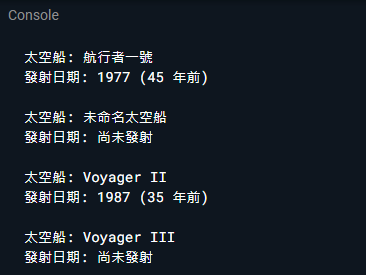
當我們要呼叫已創建的class時,就可以在mian()函式中新增符合class定義規則的物件與參數,並帶入欲執行方法
1
2
3
4
5
6
7
8
9
10
11
12
13
14
15
16
17
18
19
20
21
22
23
24
25
26
27
28
29
30
31
32
33
34
35
36
37
38
39
40
41
42
43
44
45
46
| // 定義一個 Spacecraft 類別
class Spacecraft {
String name; // 名稱屬性
DateTime? launchDate; // 發射日期屬性
// 讀取器,用來取得發射年份。使用 "=> launchDate?.year" 簡化寫法。
int? get launchYear => launchDate?.year;
// 建構子,使用語法糖(Syntactic sugar)簡化屬性賦值。
Spacecraft(this.name, this.launchDate) {
// 初始化程式碼放在這裡。
}
// 命名建構子,將參數傳遞給預設建構子。
Spacecraft.unlaunched(String name) : this(name, null);
// 方法,用來描述太空船的資訊。
void describe() {
print('太空船: $name');
// 因為 launchDate 是可為 null 的屬性,所以在這裡使用 type promotion 不適用。
var launchDate = this.launchDate;
if (launchDate != null) {
// 計算太空船發射後的年份。
int years = DateTime.now().difference(launchDate).inDays ~/ 365;
print('發射日期: $launchYear ($years 年前)\n');
} else {
print('發射日期: 尚未發射\n');
}
}
}
void main() {
// 建立一個 Spacecraft 物件,使用建構子初始化屬性。
var voyager = Spacecraft('航行者一號', DateTime(1977, 9, 5));
voyager.describe(); // 輸出'航行者一號'太空船的資訊,包括發射年份和發射後的年數。
var unnamed = Spacecraft.unlaunched('未命名太空船');
unnamed.describe(); // 輸出'未命名太空船'的太空船資訊。
//創建兩個額外的太空船物件,作為延伸要使用Spacecraft函式的範例
var voyager2 = Spacecraft('Voyager II', DateTime(1987, 8, 20));
voyager2.describe();
var voyager3 = Spacecraft.unlaunched('Voyager III');
voyager3.describe();
}
|
class範例
二、列舉(Enums)
列舉(enum)是一種有用的資料型別,它用於定義一組具有相關值的常數。這些常數可以表示一系列可能的值,提高可讀性和維護性。
1
2
3
4
5
6
7
8
9
10
11
12
13
14
15
16
17
18
19
20
21
22
23
24
25
26
27
28
29
30
31
32
33
| // 行星類型的列舉
enum PlanetType { terrestrial, gas, ice }
/// 行星列舉,列舉了我們太陽系中不同行星及其一些屬性。
enum Planet {
mercury(planetType: PlanetType.terrestrial, moons: 0, hasRings: false), // 水星
venus(planetType: PlanetType.terrestrial, moons: 0, hasRings: false), // 金星
earth(planetType: PlanetType.terrestrial, moons: 1, hasRings: false), // 地球
// ···
uranus(planetType: PlanetType.ice, moons: 27, hasRings: true), // 天王星
neptune(planetType: PlanetType.ice, moons: 14, hasRings: true); // 海王星
/// 常量生成建構子
const Planet(
{required this.planetType, required this.moons, required this.hasRings});
/// 所有實例變數都是 final
final PlanetType planetType; // 行星類型
final int moons; // 衛星數量
final bool hasRings; // 是否有環
/// 增強的列舉支援 getter 和其他方法
bool get isGiant =>
planetType == PlanetType.gas || planetType == PlanetType.ice; // 判斷是否為巨型行星
}
void main() {
final yourPlanet = Planet.earth; // 創建一個行星變數,並設置為地球
if (!yourPlanet.isGiant) {
print('你的行星不是 "巨型行星"。');
}
}
|

肆、Introduction—繼承(Inheritance)
一、延伸(extend)
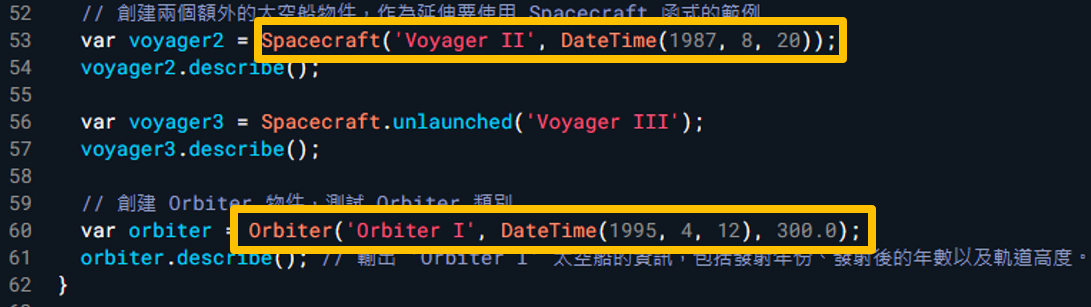
我們可以用extends的方式,將原有的Class屬性繼承,並依據需求在原有的類別上增添需要的屬性資料。例如,我們新定義一個Orbiter類別,其繼承Spacecraft,並且會新增一個”altitude”,代表軌道高度的屬性
1
2
3
4
5
6
7
8
9
10
11
| // 定義一個 Orbiter 類別,它繼承自 Spacecraft 類別
class Orbiter extends Spacecraft {
double altitude; // 定義軌道高度屬性
// 建構子,使用語法糖簡化屬性賦值
// 建構子接收三個參數:name, launchDate 和 altitude
// 使用 super 關鍵字呼叫父類別的建構子來初始化 name 和 launchDate 屬性
// 使用 this 關鍵字初始化 altitude 屬性
Orbiter(String name, DateTime launchDate, this.altitude)
: super(name, launchDate);
}
|
在使用上,Orbiter物件比原先的Spacecraft物件多了”軌道高度”的參數
二、混合(Mixins)
Mixin是一種用於在多個類別中重複使用程式碼的機制,通過with關鍵字將Mixin混合到其他類別中,使得類別可以獲得Mixin中定義的功能,提高靈活性。例如,我們定義一個”Piloted”的Mixin,具有
一個”astronauts”變數
一個”describeCrew”方法,描述太空船上的宇航員數量
1
2
3
4
5
6
7
8
9
| // 定義一個混合 (Mixin)
mixin Piloted {
int astronauts = 1; // 定義太空船上的宇航員數量
// 定義用來描述太空船上宇航員數量的方法
void describeCrew() {
print('太空人數量: $astronauts 名');
}
}
|
在使用上,我們可以透過新增”Piloted”的方式來使用額外定義原有的方法describe()與新的方法describeCrew()

三、實現(implements)
implements是一種可以將一個類別實現為多個”介面(Implicit interfaces)”,方便類別之間共享行為。例如我們定義一個”MockSpaceship”類別,他是原本”Spacecraft類別”的實現介面
1
2
3
4
5
6
7
8
9
10
11
12
13
14
15
16
17
18
19
20
21
22
23
24
| // 定義一個 MockSpaceship 類別,實現(implements) Spacecraft類別
class MockSpaceship implements Spacecraft {
@override
String name;
@override
DateTime? launchDate;
MockSpaceship(this.name, this.launchDate);
@override
int? get launchYear => launchDate?.year;
@override
void describe() {
print('太空船: $name');
var launchDate = this.launchDate;
if (launchDate != null) {
int years = DateTime.now().difference(launchDate).inDays ~/ 365;
print('發射日期: $launchYear ($years 年前)\n');
} else {
print('發射日期: 尚未發射\n');
}
}
}
|
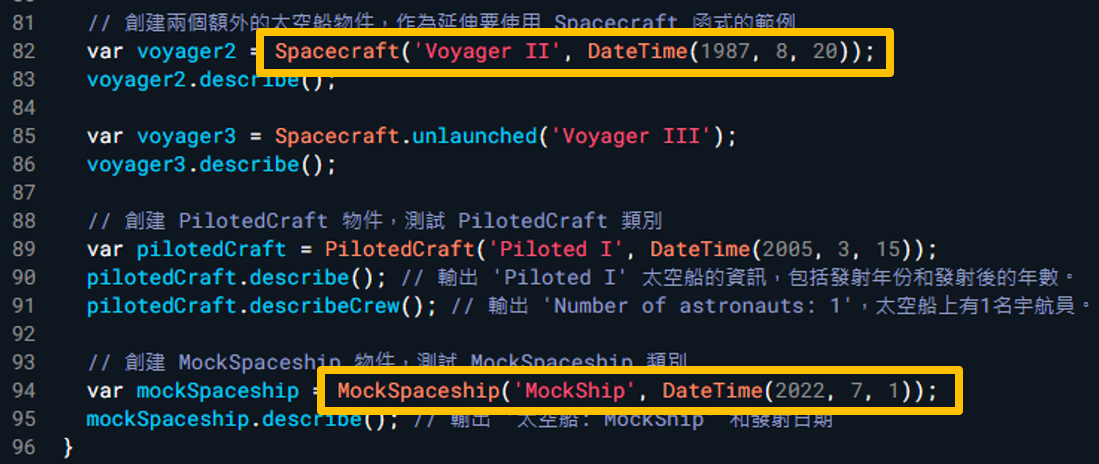
在使用上,在我們定義並實現了MockSpaceship介面後,變可以用呼叫”MockSpaceship物件”的方式達成原本呼叫”Spacecraft物件”的功能(兩個不同的類別,在”implement”的作用下,執行相同功能)
四、結合Class, Extend, Mixin, implement 綜合應用範例
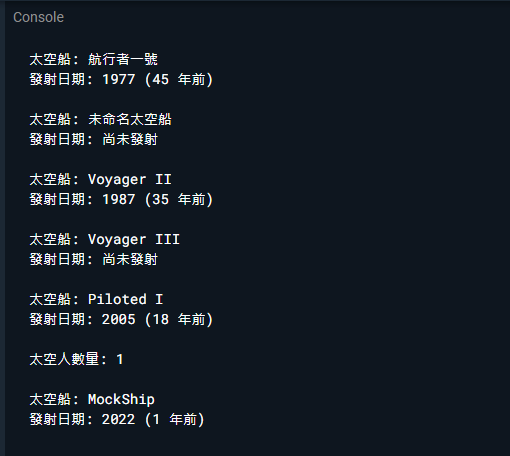
我們將原有的Class與Extend, Mixin, implement中提到的”Orbiter”、”Piloted”、”MockSpaceship”進行結合,變為以下程式範例
1
2
3
4
5
6
7
8
9
10
11
12
13
14
15
16
17
18
19
20
21
22
23
24
25
26
27
28
29
30
31
32
33
34
35
36
37
38
39
40
41
42
43
44
45
46
47
48
49
50
51
52
53
54
55
56
57
58
59
60
61
62
63
64
65
66
67
68
69
70
71
72
73
74
75
76
77
78
79
80
81
82
83
84
85
86
87
88
89
90
91
92
93
94
95
96
| // 定義一個 Spacecraft 類別
class Spacecraft {
String name; // 名稱屬性
DateTime? launchDate; // 發射日期屬性
// 讀取器,用來取得發射年份。使用 "=> launchDate?.year" 簡化寫法。
int? get launchYear => launchDate?.year;
// 建構子,使用語法糖簡(Syntactic sugar)化屬性賦值。
Spacecraft(this.name, this.launchDate) {
// 初始化程式碼放在這裡。
}
// 命名建構子,將參數傳遞給預設建構子。
Spacecraft.unlaunched(String name) : this(name, null);
// 方法,用來描述太空船的資訊。
void describe() {
print('太空船: $name');
// 因為 launchDate 是可為 null 的屬性,所以在這裡使用 type promotion 不適用。
var launchDate = this.launchDate;
if (launchDate != null) {
// 計算太空船發射後的年份。
int years = DateTime.now().difference(launchDate).inDays ~/ 365;
print('發射日期: $launchYear ($years 年前)\n');
} else {
print('發射日期: 尚未發射\n');
}
}
}
// 定義一個混合 (Mixin)
mixin Piloted {
int astronauts = 1; // 定義太空船上的宇航員數量
// 定義用來描述太空船上宇航員數量的方法
void describeCrew() {
print('太空人數量: $astronauts\n');
}
}
// 定義一個繼承 Spacecraft 並混合 Piloted 的類別
class PilotedCraft extends Spacecraft with Piloted {
// 建構子,使用 super 關鍵字呼叫父類別的建構子來初始化 name 和 launchDate 屬性
PilotedCraft(String name, DateTime launchDate) : super(name, launchDate);
}
// 定義一個 MockSpaceship 類別,實現(implements) Spacecraft類別
class MockSpaceship implements Spacecraft {
  @override
  String name;
  @override
  DateTime? launchDate;

  MockSpaceship(this.name, this.launchDate);

  @override
  int? get launchYear => launchDate?.year;

  @override
  void describe() {
    print('太空船: $name');
    var launchDate = this.launchDate;
    if (launchDate != null) {
      int years = DateTime.now().difference(launchDate).inDays ~/ 365;
      print('發射日期: $launchYear ($years 年前)\n');
    } else {
      print('發射日期: 尚未發射\n');
    }
  }
}
void main() {
// 建立一個 Spacecraft 物件,使用建構子初始化屬性。
var voyager = Spacecraft('航行者一號', DateTime(1977, 9, 5));
voyager.describe(); // 輸出'航行者一號'太空船的資訊,包括發射年份和發射後的年數。
var unnamed = Spacecraft.unlaunched('未命名太空船');
unnamed.describe(); // 輸出'未命名太空船'的太空船資訊。
// 創建兩個額外的太空船物件,作為延伸要使用 Spacecraft 函式的範例
var voyager2 = Spacecraft('Voyager II', DateTime(1987, 8, 20));
voyager2.describe();
var voyager3 = Spacecraft.unlaunched('Voyager III');
voyager3.describe();
// 創建 PilotedCraft 物件,測試 PilotedCraft 類別
var pilotedCraft = PilotedCraft('Piloted I', DateTime(2005, 3, 15));
pilotedCraft.describe(); // 輸出 'Piloted I' 太空船的資訊,包括發射年份和發射後的年數。
pilotedCraft.describeCrew(); // 輸出 'Number of astronauts: 1',太空船上有1名宇航員。
// 創建 MockSpaceship 物件,測試 MockSpaceship 類別
var mockSpaceship = MockSpaceship('MockShip', DateTime(2022, 7, 1));
mockSpaceship.describe(); // 輸出 '太空船: MockShip' 和發射日期
}
|
Inheritance範例
五、抽象(abstract)
抽象(abstract)類別可以包含抽象方法,這些方法沒有實際的程式內容,只是定義方法的規範,並且可以被具體類別繼承(extend)或實現(implement)。
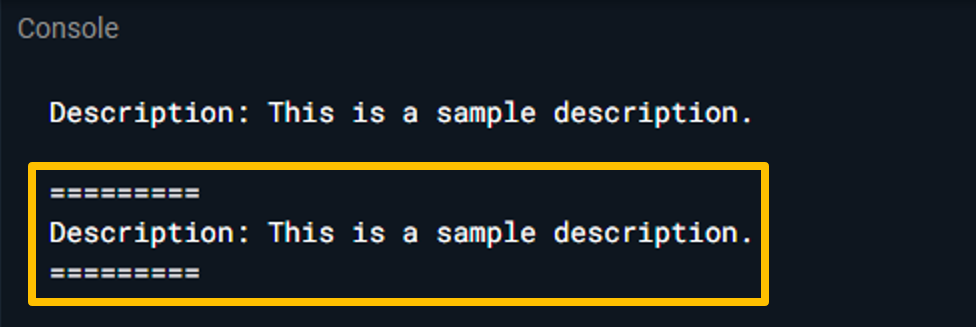
在下述範例中,”MyClass”是一個具體的類別,實現了 “Describable抽象類別”的describe() 方法,並提供了具體的描述內容。
1
2
3
4
5
6
7
8
9
10
11
12
13
14
15
16
17
18
19
20
21
22
23
24
25
26
27
28
29
30
31
32
33
| // 定義抽象類別 Describable
abstract class Describable {
void describe();//沒有方法的具體程式碼
void describeWithEmphasis() {
print('\n=========');
describe();
print('=========');
}
}
// 定義一個具體的類別,實現 Describable 抽象類別
class MyClass extends Describable {
String description;
MyClass(this.description);
@override
void describe() {
print('Description: $description');
}
}
void main() {
// 創建 MyClass 物件
var myObject = MyClass('This is a sample description.');
// 呼叫 describe() 方法,輸出
myObject.describe();
// 呼叫 describeWithEmphasis() 方法,以"強調形式"輸出
myObject.describeWithEmphasis();
}
|
abstract範例
黃框為”describeWithEmphasis()”之內容